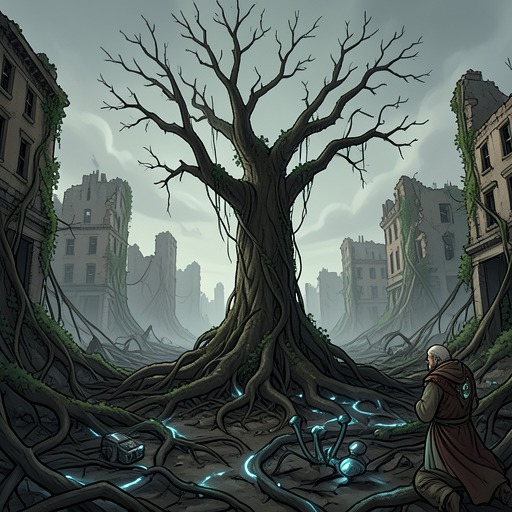
Escape from the City of Death
Chasing SunlightThe escape from the death-drunk city is a rescue and recovery action in which Jonathan Heights and his companions survive an assault by a deserted city whose invisible inhabitant weaponizes nostalgia for the instant of dying. The episode matters because the city attacks not through ordinary enemies but through an appetite that enters every body and thought, while Jonathan’s sunlight, Antomine’s command of zint, and a refusal to follow the city’s logic turn escape into an act of disciplined resistance.
The City’s Deathly Presence
The inhabitants encounter no visible or audible creature. The city’s presence is instead a raw force of lonely longing and sharp nostalgia for the moment poised between life and oblivion. It is neither death nor life, but the last instant before disappearance, and its memories and sensations strike the group with such force that everyone staggers except the two Lux Guards.
Jonathan Heights is not protected simply because sunlight fills him. The city’s ideation of dying finds purchase in flesh, stone, and insubstantial dreams alike. He grips his cane until his knuckles whiten and feels an impulse to use it against his own throat or smash his head against the stone, not from a settled wish for death but from the city’s seductive promise of reaching an exquisite final moment. Eleanor McAvey is similarly overwhelmed, trembling around her dagger and unable to say more than that she cannot continue. Sarah and Marie faint under the pressure.
Antomine responds by imposing practical control on the crisis. His eyes begin to glow, and at his gesture one Lux Guard removes Eleanor’s dagger and carries her while the other assists the maids. Jonathan steadies himself by separating the city’s suggestions from the parts of himself that belong to sunlight. The thoughts do not disappear, but recognizing them as alien reduces them to an insistent murmur rather than an unquestioned command. The saboteur’s death has apparently intensified the city’s appetite, making departure urgent rather than optional.
Recovery of the Luminiferous Gems
Antomine orders an immediate departure, but Jonathan remains attentive to the purpose of the expedition. He hooks the saboteur’s sled with his cane and opens the bag resting on it. Inside, the stolen luminiferous gems still shine from the broken glass-and-steel mechanism taken from the Endeavor. Jonathan seizes the device before turning back toward the ship.
The recovery creates a brief conflict between the two men. Antomine says that he needs the mechanism, and Jonathan nearly pulls it away. He restrains himself because the inquisitor is not the enemy, while also recognizing that containing sunlight requires iron discipline. He hands over the zint device rather than allowing the city’s pressure or his own possessiveness to fracture the alliance.
When Antomine takes the mechanism, the gems flare and then dim as his eyes brighten almost equally. The mental assault recedes to a background scratching of suicidal contemplation. This does not eliminate the city’s influence, but it makes resistance possible. The Lux Guards remain immune, a condition Jonathan suspects results from their having been touched and altered by the Illuminated King; their lives may therefore not be theirs to spend. Eleanor regains her feet, retrieves her dagger, and thanks Antomine, while Jonathan follows her lead in acknowledging the inquisitor’s intervention.
Choosing a Straight Line
Jonathan proposes that the group travel in a straight line rather than attempt to understand or obey the city’s design. He offers his pistol to Antomine and states that the best way to frustrate such a place is to refuse to play by its rules. The decision converts the escape from a search for the city’s safe route into a deliberate rejection of its power to dictate movement and perception.
Antomine extracts the luminiferous gems, places the mechanism in a pocket, and fires the pistol while using the gems as its power source. The beam flashes like lightning and punches a round hole through walls and lampposts, leaving a blue-white zint glow that marks a route toward a distant gas lamp. Jonathan corrects the weapon’s trajectory, keeping Antomine aimed toward the ship. The destructive shot is therefore also a navigational instrument: material force cuts through the city’s maze and exposes a direction that can be followed.
Jonathan releases some of his control and lets sunlight rise through his soul, driving away the city’s whispered suggestions. Yet the moment is dangerous because surrendering too fully to sunlight could make him lose the steps between his present position and his goal. When Antomine falters, Jonathan lifts him and continues running, carrying the young inquisitor despite blood glowing with zint-light on Antomine’s injured fingertip.
Eleanor, after her earlier collapse, crosses the opened passages without difficulty, resisting the pressing need to stop and bleed out. In a straight line, the ship is only about a minute of full sprint away. The Endeavor appears both familiar and strange, disguised by the unknowable ship’s name covering it, while the death-drunk city rising on either side makes Jonathan briefly doubt whether the group has reached the correct place. The doubt passes, and the survivors hurry toward the tether before the city can summon an actual force or creature instead of relying only on feeling and perception.
Return to the Endeavor
The crew at the descent line recognize the sudden change in the city’s attitude and signal with whistles. Two airmen remain at the line even though they too have been exposed to the city’s effect, and their endurance earns Jonathan’s grudging respect. The guards go first, followed by the others; Jonathan catches a handhold, wedges his boot into another, and continues holding Antomine while the line is hauled upward.
The escape succeeds because the group combines several forms of resistance rather than relying on one protection. Sunlight lets Jonathan identify and contain the city’s thoughts, Antomine’s zint-powered weapon weakens the assault and cuts a path, Eleanor continues moving despite the death impulse, the Lux Guards maintain physical control over the incapacitated, and the airmen operate the tether under pressure. The city is not defeated or transformed; its influence is simply outrun before it can give its emotional attack a bodily form.
Consequences and Expeditionary Value
The recovered device and gems preserve the practical purpose of the expedition even as the escape reveals the cost of entering the deserted city. Elsewhere, the Endeavor’s preparations depend on portable luminiferous terrestrite equipment, lifting-gas machinery, water systems, searchlights, zint guns, food, clothing, spare parts, and raw materials. The episode consequently belongs to a wider pattern in which extraordinary encounters are folded back into logistics: survival must be converted into continued travel, and every recovered resource affects the ship’s capacity to proceed east.
That material logic becomes especially visible when the expedition later treats discoveries as cargo. Jonathan arranges supplies toward Danby’s Point, advises that steel is more valuable for barter than gold or silver, carries heavy finds when necessary to preserve crew morale, and buys flowers, spices, steel, and brass in Ukaresh. The escape from the city therefore stands between two economies of value. Within the city, the stolen gems are indispensable instruments of survival; beyond it, metal, equipment, and recovered wealth become provisions, bargaining assets, and eventually the source of the battered Endeavor’s public fame.
By the return voyage, the Endeavor brings back an immense quantity of gold, attracting more attention in Beacon than the inquisitor or the three women who disembark. The city’s most immediate legacy is thus paradoxical: it nearly reduces the expedition to suicidal desire, yet the survivors emerge carrying material wealth that helps make repair possible. Its deeper significance remains more disturbing. The expedition’s profits cannot erase the fact that the group escaped by refusing an environment that made death feel like home, and that Jonathan’s continued pursuit of sunlight required him to distinguish illumination from another form of surrender.